Cara Augustenborg
  • Home
  • The Verdant Yank
    • Cara goes to France
    • Climate Friday FAQs
  • Down To Earth
  • Media Appearances
    • Watch
    • Read
    • Listen
  • Upcoming Events
  • Gallery
  • About Cara
    • Publications

Business and Environment: Day 3 at Trinity Business School

3/31/2016

0 Comments

 
I didn't think this course could get any better after yesterday, but somehow Trinity's Finance students continued to impress! It was "Sustainability Day" in class today, and we kicked it off in beautiful style with a presentation from Dr. Natasha Williams O'Hanolan - Sustainability Adviser for Oriflame Cosmetics company. I already knew Natasha's fantastic reputation, but I was seriously impressed by the ambitious nature of her company's efforts to create truly sustainable products. Their story was great inspiration for students to realize genuine sustainability is possible AND profitable!

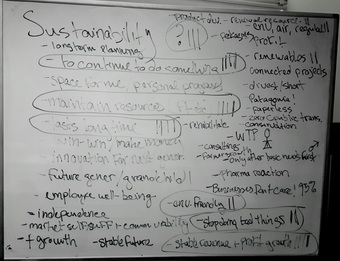
I've never been a big fan of the word "sustainability" myself because of the diverse interpretations of the word, so I sent students out into the field to find out how real people define sustainability. Not surprisingly, they found a wide range of views on the topic, demonstrating how easy it is for a company to get sustainability wrong when nobody seems to agree on how it's defined. 
Picture
In the afternoon, we brought a bit of Parliamentary style into the classroom by having a full-fledged debate on decoupling, with students answering the question: Can we really decouple economic growth and GDP from environmental impacts? Their informed arguments and enthusiasm were a joy to behold! 

And finally, we rounded off Sustainability Day with a guest lecture from CSR manager David O'Flynn of Dawn Meats -who impressed students with real evidence that "there is huge money to be made in sustainability". 

Watch my 2 minute chat with David after class here:

What's happening on our final day of #EcoBizTCD?

  • Putting a price on nature – It’s no April Fool’s joke! We’re talking natural capital and ecosystem valuation this morning, starting with a guest lecture from the amazing Paul Harris of Sustainability Matters.
  • Finishing off our marathon, we’ll be looking at environmental marketing (how to avoid greenwashing!) and eco-entrepreneurship.
  • Finally, it’s nail-biting time for me as students survey the course and I find out once-and-for-all if this crazy idea was a transformative experience or simply just a lesson learned!

0 Comments

Business and Environment: Day 2 at Trinity

3/30/2016

0 Comments

 
Today was quite possibly the best lecturing experience I've ever had. Most of the time, I'm preaching to the choir so this week is unusual for me as I'm "preaching" to our future financiers, who are usually not known for their environmentalism. 

On Day 2, we went through a crash course in the 9 planetary boundaries and then moved on to my favorite topic of climate change. I wanted them to be as interested in climate impacts and solutions as I am, so I gave every ounce of energy I could muster to convey just how urgent the climate crisis is and what a challenge we have ahead of us to fix it. 

It came as a surprise to me that not one of the students in the class had heard of the concept of unburnable carbon and the potential that fossil fuels will become stranded assets. Watching them fully comprehend that revelation was a real moment for me -The kind of moment that makes you love teaching. 

Even better, I got to share the day with my former student and now climate colleague, Gar Tyrrell. Listen to our 2.5 min chat about what happened: 

What's happening on Day 3 (March 31)?

It’s “Sustainability Day” here at TCD Business School! I must admit I’ve never been a fan of the word because of its multiple interpretations, so today I want to set the record straight on what true sustainability really is.
  • We’re starting the morning off with a guest lecturer from Dr. Natasha Williams O’Hanlon of Oriflame Cosmetics. She’ll be explaining how the cosmetics industry addresses sustainability.
  • We’re going out in the field, interviewing people on the street to find out what they think sustainability is. We’ll see if I’m right about just how confusing this term can be!
  • We’re looking at the Brundtland definition of sustainability and how it applies to business, including the UN Global Compact and UN Sustainable Development Goals.
  • We’re resolving the differences between Corporate Social Responsibility (CSR) and Corporate Sustainability 
  • We’re looking at the emerging Irish bioenergy sector and what it needs to do to aspire to true sustainability.
  • We’re looking at agriculture and food production and trying to figure out how to feed the 9 billion people while available arable land declines.
  • All that talk about food made us hungry, so after a lunch break we debate on the concept of decoupling. Is it really possible or is George Monbiot right when he calls it a “false promise”? And if so, what’s the alternative?
Now we know WHY we need to protect the environment in our business practices, so how do we legislate and manage accordingly?
  • In the afternoon, we’ll look at different kinds of environmental legislation, the impacts to business, and the guiding principles and tools of environmental legislation.
  • We’ll look at ISO-14001 as a standard for environmental management using Tata Global Beverages (makers of Tetley Tea) as a case study.
  • We’ll finish off this section with an explanation of the Equator Principles for financial institutions and how if more banks signed on to such a concept, we might alleviate recent environmental and human rights conflicts.
At the end of the day, we’ll return to sustainability with a guest lecture from former Origin Green Ambassador now of Dawn Meats, David O’Flynn. My environmental colleagues’ jaws may drop upon seeing the words meat and sustainability in the same sentence, but we’re exploring the issue from all sides and I’m looking forward to seeing what comes out of the discussion. 
0 Comments

Business and Environment Interface: Day 1 at Trinity

3/29/2016

0 Comments

 
Great start to my week teaching at Trinity today... Students knocked it out of the park with presentations on past environmental disasters involving businesses and presented on everything from nuclear accidents, oil spills, Easter Island, and Minimata disease. They also did a great job making ethical arguments for paying for carbon emissions in the aviation industry and protecting water quality in the Amazon. 

We ended the day with a pretty shocking guest lecture from John Gibbons where students really challenged him on the link between economics and natural resources, once again proving that there is value in standing at the interface between disciplines. I sat down for a pint of the black stuff with John after class - You can see from our one minute together that he certainly has a way with words! 

Watch: 1 minute with John Gibbons after Day 1

What's happening on day 2 at #EcoBizTCD (Wed. March 30)?

  • It’s a baptism of fire for finance students with a crash course in environmental science, starting with a discussion on ‘The Limits to Growth’ and a significant part of the day dedicated to explaining the nine ‘Planetary Boundaries’
  • We’re looking at the alcoholic beverage industry and the biopharmaceutical industry among others to see what kind of environmental impacts they have and how they can resolve those impacts.
  • Any course I teach wouldn’t be complete without a dedicated lecture on climate change!
    • ​​I’m drawing on Al Gore’s beautiful slides to convey the science and impacts of climate change and drawing on the great work from Carbon Tracker to convey the concept of the carbon budget and the unburnable carbon. 
    • When it comes to business and climate change “solutions” is the name of the game, so we’ll be talking about the opportunities in renewable energy, energy efficiency, transportation and food production
    • Our discussion on climate is capped off by an overview of where climate policy is headed globally and to throw a bit of debate into the mix, we’ll finish with a brief discussion of Naomi Klein’s work on the link between capitalism and climate change from ‘This Changes Everything’.
  • After lunch, we’re joined by energy economics lecturer and climate activist, Gar Tyrell, to follow the money.
  • At the end of the day, students will select one of the ten industries most likely to be impacted by climate change and analyse their risks, potential solutions and maybe even potential opportunities in a changing climate. 

Follow the fun on Twitter at #EcoBizTCD!

0 Comments

Making magic at the interface: Teaching Business & Environment at Trinity College Dublin

3/28/2016

0 Comments

 
Picture
In 2002, I took a course as a grad student at the University of California Los Angeles (UCLA) in their MBA program called “Business and the Environment”. For a scientist with zero business experience, it was one of those mind-altering classes that changed my perspective on life.
The inspirational nature of the course wasn’t just because the subject matter was new and felt more tangible and applicable to my daily life than the usual chemistry and biology classes I endured. More so, I was struck by the magic that took place when scientists joined forces with MBA students. 

How shade-grown coffee woke me up!


​One of my own group projects for the course involved a business case analysis for shade grown coffee, culminating in a presentation to the class on the potential market opportunity of shade-grown coffee that also involved a taste test of shade-grown verses intensively-grown coffee beans. Shade-grown won!
Picture
easywaytogreen.com
It’s easy for the years of university-life to blur into each other, but this was one of the projects that really stood out in my decade as a college student. For the scientist in me, it was a challenge to make an economic and business argument for growing coffee under the more environmentally-friendly conditions of a shady rainforest. For my fellow group members from the business sector, it was equally challenging to get their head around the environmental and social interactions of producing coffee.  

The experience was the first time I experienced what HIV researcher Dr. Reid Rubsamen once said:   
“The greatest opportunity occurs at the interface between two disciplines.”
From that moment, I shunned the traditional academic career path to “specialize” and aspired to remain at the interface between disciplines.  
​

A set-back in my career ambitions

Moving to Ireland in 2003 soon made me aware of what a tricky career path I’d decided to carve out. My publication record covered everything from storm-water policy and livestock waste management to supply chain finance. When I was passed by for a permanent lecturing post at an Irish university, I was told they didn’t want multi-disciplinary expertise but rather someone who “had such a narrow range of expertise that they could be a global leader in that topic” (because almost no one else was studying that topic, not that I'm bitter...).

I felt sick hearing these words – Had I wasted twelve years of my life in university soaking up knowledge on everything only to find that I wasn’t specialised enough to have a career? “Jack of all trades, Master of none” was now my cross to bear as a result of my foolish desire to know something about everything.
​

Just a little patience...

In 2007, while working on a short post-doc in Trinity Business School, I was fortunate enough to make the acquaintance of Economics guru, Prof. Brian Lucey. During one of our coffee breaks, I expressed my frustration with Irish academia and told him of my amazing experience in UCLA’s Business School. Many of the American universities were already offering “Green MBAs” at the time. Why hadn't Ireland caught up?

It seemed there wasn’t a business school in the country that required their students to have some understanding of environmental issues, despite the fact that our economic growth is ruthlessly bound to natural resource extraction and every business has to operate within the confines of environmental regulation. 
​

Prof. Lucey is known publicly for his unique approach to business and economics and I’m eternally grateful to him for hearing me out. He accepted my proposal to teach Trinity’s finance M.Sc. students a course in business and the environment. So this week, after eight patient years, I get to live my dream teaching a 25-hour course in business and the natural environment thanks to Prof. Lucey’s initiative. 
​

Dreams are scary when they become reality

The workload in designing a course from scratch is immense, and there’s always the fear that the discipline of environmental science will be so foreign to finance students that I’ll be looking down at vacant stares for the next 4 days of my life.

​But the scariest things in life always teach us the most, so I’m diving in head first. I’m extremely fortunate that several of Ireland’s business and environmental leaders have agreed to join me for guest lectures so I have some great company on this adventure!
​

A lot of people I’ve talked to about this course are curious about how it will go. My peers have asked:
  • How do you teach finance students about natural environment? How will they respond?
  • How will they resolve traditional economics with potential impacts on the environment?
  • How can you explain the potential impacts of climate change to business when the science and time scales of those impacts are uncertain?
  • And the most frequently asked question: How will you physically endure teaching for 25 hours consolidated in 4 days?? – That’s the question I’m the least able to answer as Trinity’s course format is certainly unique in that respect!  
​​

Share my adventure!

There’s been so much interest in what I’m about to do that I thought I might as well document the experience publicly. If you’re interested in following along, check out #EcoBizTCD on Twitter or keep tuning in to CaraAugustenborg.com, where I’ll post daily updates on the subjects we’re covering, the guest speakers, and (if I can muster the energy) vlogs on how we got on at the end of each day. 
Picture
I’m looking forward to a week at the interface between two disciplines. Stay tuned to find out what magic gets made!

And as always, keep fighting the good fight!
​-Cara

Check out my daily blogs and vlogs from #EcoBizTCD:

Day One - Tuesday, March 26th - Business & Environment

 Day Two - Wednesday, March 27th - Planetary Boundaries

Day Three - Thursday, March 28th - Sustainability

And watch a final outgoing discussion between some of my students and I on Day Four:

0 Comments

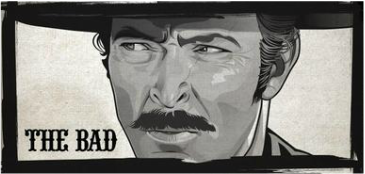
The Good, The Bad, and The Ugly – My struggle with the Transatlantic Trade and Investment Partnership (TTIP)

3/15/2016

4 Comments

 
Picture
Happy St. Patrick's day! This is the first post of my newest blogging effort: The Verdant Yank - Find out why I'm labeling myself with this outlandish title here. 

No time to read? Watch my quirky v-log version on TTIP: Cream cakes and a flat earth

The Good, The Bad, & The Ugly on TTIP

"Just promise me you'll keep an open mind"

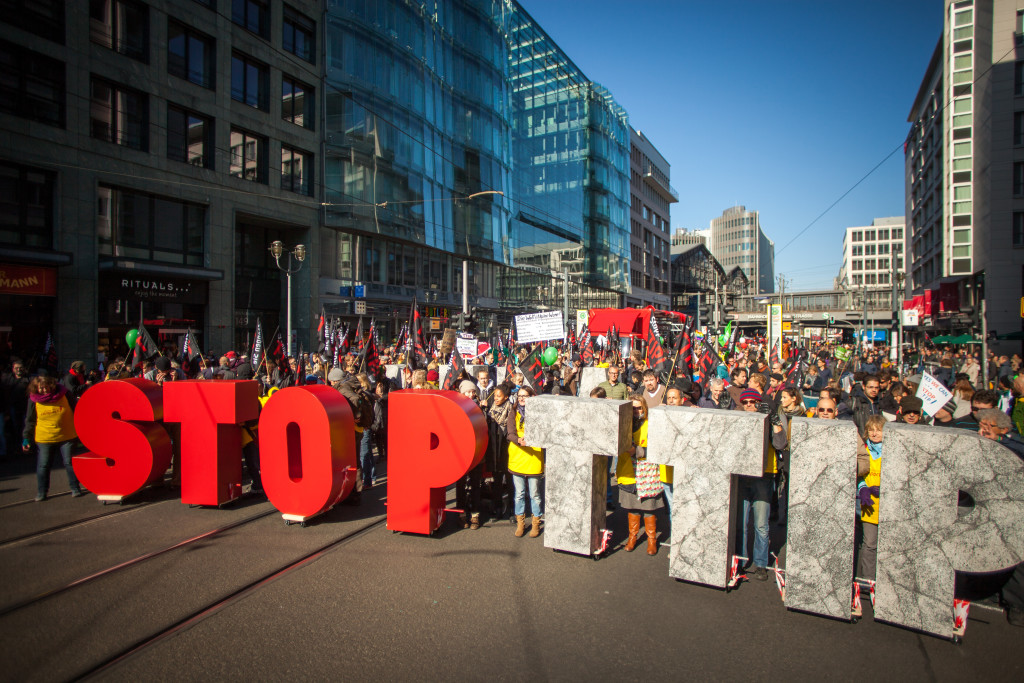
That’s what an American friend of mine said as I groaned when he gave me the news he was working on TTIP - The Transatlantic Trade and Investment Partnership.  TTIP has been described by the European Trade Commissioner as ‘the most contested acronym in Europe”: Over 250,000 people took part in protests about it throughout Europe last October; Swedish people have been hosting “TTIP parties” to share their concerns about it with friends and neighbours; and Flash Mobs are appearing all over Europe (and YouTube) singing against TTIP!
​

Here’s where my dual Irish-American allegiances get me tied in knots. My American friend is smart and I value his opinion that TTIP may not be the wrecking-ball that some claim. It’s also being championed by President Obama, whose views I generally align with. However, my European friends are smart too and they’re fighting TTIP tooth-and-nail. I’m a little confused as to why all these smart people are on completely opposite sides of the fence when it comes to a trade agreement.  Thus, I could think of no better way to kick off my new ‘Verdant Yank’ blog on St. Patricks’ Day than by exploring the Good, the Bad, and the Ugly of TTIP with an open Irish-American mind…  Read on to find out if all the fuss over TTIP is justified. 

What is TTIP?

TTIP is a transatlantic trade agreement between Europe and the USA, creating the world’s biggest free-trade zone, to harmonise regulatory standards, cut prohibitive tariffs, and help companies do more transatlantic business. It will impact 800 million consumers throughout the USA and Europe. Talks between EU and U.S. negotiators began in July 2013, but stalled due to widespread public protests on everything from its impacts on the health care to feta cheese. Now US and EU negotiators are scrambling to reach agreement before President Barack Obama leaves office in January 2017. They entered their 12th round of negotiations last month with the aim of having a draft deal by July 2016. 
Picture
It’s hard to find much good news in the media about TTIP, but the TTIP negotiators themselves point to a number of benefits if the trade agreement is passed. They say: 
the agreement would be of “great geostrategic and geo-economic value in terms of strengthening Transatlantic ties and enhancing our ability to define a global rules-based architecture” and this will “promote economic growth, liberalism and democracy globally”.
​
If you’re anything like me, you cringe when you see an economic trade agreement equated with the promotion of democracy, but (with an open mind) I found there is evidence demonstrating a correlation between the economic openness of a country and the political and civil freedom it grants its citizens. However, this effect is more pronounced in countries where the capital-to-labour ratio is high (i.e. developing countries, rather than places like USA or EU Member States). Some of the more specific benefits TTIP proponents point to:
  • Increased investment and employment in both the US and EU
  • Further reduction or complete elimination of Transatlantic trade tariffs
  • Closer regulatory cooperation to reduce cost and burden for export companies, particularly small and medium enterprises (SMEs) who struggle to engage in Transatlantic trade due to lack of resources.
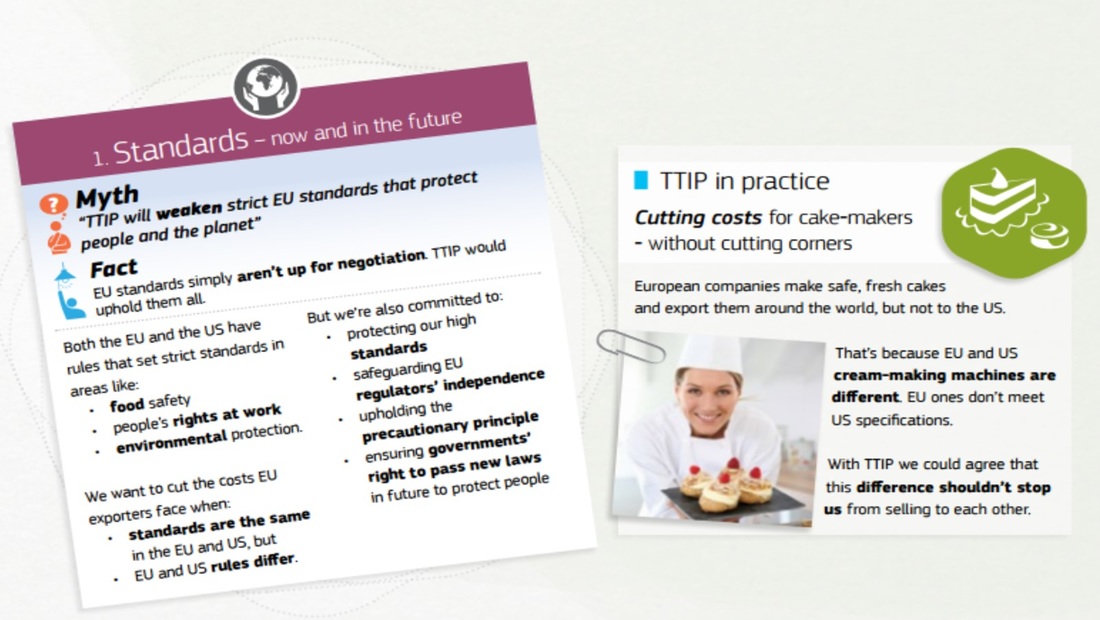
However, all these benefits are generalisations and I couldn’t find any quantifiable evidence to support them. The best I could find was this little pdf from the European Commission dispelling the top ten myths about TTIP. While their myth-busting arguments sound idyllic (think of French bakers getting to sell their lovely cream cakes to hungry Americans, pictured below), everything good about TTIP seems to be hypothetical, unquantifiable, and uncertain. 
Picture
There is one really good thing about TTIP that is already being demonstrated though - It’s caused millions of people in Europe and the USA to mobilise to challenge it. Sitting around a table of Irish unions, lobby groups, and charities at a TTIP negotiating briefing the other day, I was struck that for the first time we had common ground in our concern for something: ENGOs are concerned about the impact of TTIP on environmental standards; farmers are concerned about its impact on beef and dairy; health charities are concerned about its impact on healthcare; and unions are concerned about its impact on jobs and wages. 
And it’s not just professional groups who are concerned. -I’ve never seen so many young people follow and fight a trade negotiation either. That may sound like a bad thing, but to me, this is evidence of a renewed interest and mobilisation for social change. Maybe TTIP really is a vehicle to promote democracy, but not in the way negotiators presume. 
Picture
arc2020.eu
Picture

​If you want the bad news, just type TTIP into google and you’ll be reading for weeks! Here are some of the risks of TTIP that I found:
  • Encouragement of mass imports of key agricultural products from USA to Europe, further burdening European agricultural competitiveness. This is a particular concern for the Irish beef and dairy industries.  
  • Potential to soften US banking regulations and give too much power to banks, particularly in the US which had tightened up banking regulations in recent years.  
  • Potential to cause “considerable levels of joblessness” in Europe.
  • TTIP prevents cooperation with Russia and could even inflict economic war on Russia via a common Euro-Atlantic economic region
  • Driven by the weak Euro, TTIP could increase the ability of  U.S. companies to take-over European companies (e.g. GM taking over VW).
​

 And here are some of the bigger, badder issues TTIP concerns:

Secrecy: TTIP negotiators state this is the most transparent trade agreement process in history but trade negotiations are like chess, which is why the negotiators are keeping their moves particularly secretive. European Parliamentarians, bound by strict confidentiality agreements, are the only stakeholders allowed to read the draft TTIP text and must do so in secure reading rooms so they cannot report on their findings. How’s that for democracy?

After reading the draft text, German MEP Katja Kipping claimed TTIP had “secrecy written all over it” and “without a legal commentary, [MEPs] are still in the dark as to the potential impacts of many of the terms used.”

​It’s not surprising that trade agreements of the past were not aired in public given the technology available at the time, but we live online now so there’s no excuse for negotiators not to publish draft text for everyone to see, particularly if this agreement benefits Americans and Europeans as much as they claim it does. TTIP negotiators could take a hint from the UN climate negotiations and their virtual participation via the publically available Negotiator app if they need evidence that transparency is easy to achieve in this day and age. 
Regulatory 'convergence' - TTIP’s “regulatory convergence” agenda seeks to bring EU standards closer to those in the US or vice versa.  Think about those crème cakes again and how much easier it would be for French bakers to sell them to Americans if only the US and EU regulations on crème machines ‘converged’! However, US food safety regulations are generally less rigid that their European counterparts, which could result in declining food standards in Europe as a result of TTIP, including the sale of genetically modified products and foods doused in hormones and pesticides. 

Proponents say TTIP is not about harmonizing to the lowest common denominator (downward harmonization) but aligning regulatory processes where it benefits both businesses and consumers (crème cakes!), but consider products where the US and Europe have differed significantly, such as gun sales, chemicals, and smoking regulations. - The jury is still out on how regulatory convergence would impact such issues.

​Even if we believe negotiators when they say ‘downward harmonization’ of regulations won’t take place, the EUs higher regulatory standards generally results in more expensive products and those more expensive products won’t be able to compete with cheaper U.S. imports subject to lower standards. U.S. chlorinated chicken is a prime example of this kind of risk. -With or without regulatory convergence, we can expect to be eating it here in Europe if TTIP has its way.  
Clandestine courts - Since the 1960s, trade treaties typically include an ‘investor-state dispute settlement’ mechanism or 'ISDS.' This is a special trade court that allows companies to sue foreign governments when their profits are compromised if a government introduces new laws or practices. Generally, these cases are conducted in clandestine court settings where an unelected panel of trade lawyers make judgments about what a country owes the foreign investors who take claims against governments.

The ISDS (or the newly proposed ‘Investor Court System’) is one of the most contentious aspects of TTIP.  As economist Joseph Stiglitz points out, the ISDS would mean “every time you passed a regulation against asbestos or anything else, you would be sued…You can write the regulation. You would just have to keep writing a check to Philip Morris to make up for the profits that they would have had if they were able to kill people like they were able to in the past.”

Since TTIP text is not available for public analysis every argument (both for and against) is hypothetical, but at least we can look at past trade agreements to evaluate the merit of the ISDS:
  • Corporations have used ISDS to challenge governments over 600 times, and many of these challenges are clearly related to health or environmental decisions by governments.
  • United Nations figures reveal American firms have sued states on 130 separate occasions under free-trade agreements since the year 2000.
  • Just to name a few examples:
    • Phillip Morris sued Australia and Uruguay for placing health warnings on cigarette packets. Although the challenge failed, the Australian government spent an estimated A$50m of taxpayers’ money defending their 2011 law.
    • Under the North American Free Trade Agreement (NAFTA), a US investor tried to open a toxic waste dump in Mexico. While the Mexican federal and state governments had approved it, the city government refused to give them a permit. The investor sued and won a judgment against Mexico for cutting into the profits he expected he would get by opening this toxic waste dump. Mexico had to pay the investor $16 million so that a city could control its own zoning.
    • Under existing treaties, a Swedish electric utility owning power plants in Germany has sued Germany twice. In the first case, German had to roll back on environmental regulations at the company’s request. In the second case (pending), the utility wants compensation for Germany's response to the Fukushima disaster to shut down their nuclear plants.
    • In 2010, the United States challenged one of China’s wind power subsidy programs on the grounds that it contained supports for local industry that were considered protectionist.
    • Recently, TransCanada announced it was suing the US government for $15bn after the Obama administration rejected the Keystone XL pipeline to pump oil from the tar sands of Canada on environmental grounds.
    • Canada is facing $2.6 billion in challenges from American corporations under NAFTA, including challenges on bans against environmental harmful additives to gasoline, exports of hazardous PCBs and lawn pesticides, and moratoriums on fracking.
TTIP proponents argue the number of cases taken by investors within ISDS are declining and are usually unsuccessful, but ISDS opens up a can of worms, costs tax-payers billions, and inevitably makes governments nervous of enacting legislative changes that benefit consumers at the expense of foreign investors. It’s understandable that companies need rights and dispute mechanisms to protect their investments, but do they need a special, undemocratic court and the right to waste tax payers’ money when things don’t work out well for their bottom-line? Why aren’t the 800 million consumers who will be impacted by TTIP offered the same level of protection? 

And what of the climate?

From my point of view, the part of TTIP I worry most about is its potentially negative effect on our ability to tackle climate change. Given the successful ratification of the Paris Climate Agreement, we know that each signatory country now has to change their laws and practices accordingly, but under TTIP’s ISDS mechanism, foreign corporations can challenge anything that might negatively impact their profits and could therefore undermine the Paris Agreement by fighting regulatory changes that may result from it.
​
This is already starting to happen. -In 2012, the U.S. oil company Lone Pine used NAFTA to challenge Quebec’s fracking moratorium. The European Union’s trade commissioner has already told ExxonMobil that TTIP would help remove obstacles to fossil fuel development in Africa and South America when we know we need to get off fossil fuels right now to slow down climate change. In addition, Governments that are already weak on climate action (e.g. Ireland) may cave to corporate pressure so as not to appear anti-trade and argue their hands are tied on climate action rather than take the necessary steps to reduce greenhouse gas emissions in line with the Paris Climate Agreement. Remember that the Paris Agreement isn’t legally binding but TTIP is, so it’s a no-brainer where governments are going to focus most of their risk-averse behaviours. 

TTIP - wrapping up the Bad

Since almost nobody gets to read TTIP, it’s impossible to evaluate the risk of all these hypothetical problems. So I leave the last word on the bad bits to the one person who has recently read and reported on TTIP draft text. She wasn’t allowed to report on what was in the text, but German MEP Katja Kipping did go so far as to say what wasn’t in the text:
“I read nothing to alleviate my concern that the US side wishes to make life more difficult for public and community enterprises and to secure better terms for transnational corporations in the battle for public tenders. I also read nothing to calm my fears that EU negotiators are prepared to sacrifice our social and environmental standards for the prospect of winning lucrative contracts for big European firms. I read nothing that would lead me to reconsider my previous criticism that consumer protection plays no part in TTIP other than to proclaim free market competition to be the highest form of consumer protection that exists.”
​

PicturePhoto: Darvell and Sons

​You can think about the cream cakes and how TTIP would open up a market for such deliciousness, or you can be like Katja -concerned about the risks that TTIP poses in all other aspects of our life. 

Picture
What’s the difference between bad and ugly? When I looked into TTIP, I wanted to find out if there was any way to make it better so that it could serve the needs of all the stakeholders, including both businesses and consumers. The “bad” bits can still be fixed: 
Negotiators could make TTIP far more transparent; ensure regulatory convergence doesn’t compromise consumer protections; throw out the ISDS altogether or give it an equally-important role for citizen protection; and include wording to safeguard governments who introduce measures to address climate change.

The “ugly” bits are issues that can’t be fixed by TTIP and look more generally at who benefits from free trade agreements: 
​
Almost all free trade agreements (FTAs) include a provision for “national treatment” so governments cannot discriminate between goods produced by local companies and those produced by foreign firms. We’ve been told by our governments to “Buy Local” or “Buy American” to help strengthen our local economies, but with TTIP all that is out the window because such behaviour would be considered “protectionist” and anti-trade.

Instead, what we create with FTAs is a race to the bottom of the labour market. Thomas Friedman calls it a “flat earth,” or a flat labour market, with uniformly low production costs aspiring for full globalization. This means that workers in FTA countries will eventually all make the same wage as we reach some kind of global mean, where workers in high-wage countries (e.g. Ireland) drop down to lower wages in line with the other partner countries. This is ideal for multi-national corporations, but is this what we want for the citizens of Europe or America? Do we want a complete interdependence of the European and US economies in an era when we know that diversity is a safer bet?

​Economist Frank Ackermann reminds us there is no huge barrier to trade between the US and Europe right now. -Goods flow back and forth all the time and most tariffs are less than 3% in either direction. Rather, TTIP appears to be “a solution looking for a problem” or simply an opportunity for corporations to roll back the rules that the US or Europe has adopted. Worse still, we won’t comprehend its full consequences until 20-30 years into the agreement. Case and point, NAFTA...

​This week, Rep. Louise Slaughter (D) of New York stated: 
“I have never seen a trade agreement that benefited the American manufacturer or American worker. We were decimated by NAFTA and have lost tens of thousands of manufacturing jobs in my area since it went into effect, culminating in one of the highest poverty rates in the country…The destruction wreaked by NAFTA can be seen in thousands of hollowed out towns across the United States, if you trust the bridges to get you there and are willing to risk drinking the water.” 

​Maybe Bernie Sanders put it best when he said of America’s trade policies: 
“The decimation of Detroit, Flint and communities all over this country did not happen by accident. It is a direct result of disastrous trade deals that have allowed corporations to ship our jobs to low-wage countries…Not only has our trade policy cost us millions of decent paying jobs, it has led to a race to the bottom. American workers are forced to compete against desperate workers abroad who make pennies an hour.”
Does Ireland really want to race to the bottom of TTIP and become the next Detroit? Enda Kenny seems to think so, but do the rest of us? 
Enda Kenny "We're very big supporters of T-TIP"

Enda Kenny "We're very big supporters of T-TIP"

Posted by Brian Ó HUiginn on Sunday, March 13, 2016

​I tried to give those who support TTIP the benefit of the doubt and assume they were all trying to “do the right thing”. I wanted to see TTIP as nothing more than an effort to reach across the pond to boost our mutual economies, but even if you fixed all the bad bits detailed above, you’d still be left with the overall ethos of free trade that prioritises corporations’ well-being over citizens’. No one seems to have learned anything from the mistakes of NAFTA, and until they do I’m calling bull on this kind of “trickle down” free trade mentality.

​For TTIP to gain any public support, negotiators need to tackle the most glaring “bad bits” immediately (rather than leaving them until the end as they plan to) and our governments need to revisit the whole concept of FTAs in general. Globally-traded cream cakes may be great, but who wants to live on a flat earth?
Picture
If you want to get more involved in TTIP, check out the great work that Friends of the Earth and many other NGOs are doing right now.

Happy St. Patrick's day and thanks for reading my first 'Verdant Yank' blog post. Keep fighting the good fight!

-Cara   

Get notified of my next blog post by subscribing here:

Subscribe to Cara's mailing list
4 Comments

    Archives

    December 2021
    September 2019
    October 2018
    February 2018
    January 2018
    September 2017
    May 2017
    March 2017
    February 2017
    January 2017
    December 2016
    November 2016
    October 2016
    September 2016
    August 2016
    July 2016
    June 2016
    April 2016
    March 2016
    February 2016
    January 2016
    December 2015
    November 2015
    October 2015
    September 2015
    June 2015
    April 2015
    March 2015
    February 2015
    January 2015
    December 2014
    September 2014
    May 2014
    April 2014
    February 2014
    January 2014

    Categories

    All
    Elections
    Electoral_registar
    Green
    Vote

    RSS Feed

Powered by Create your own unique website with customizable templates.