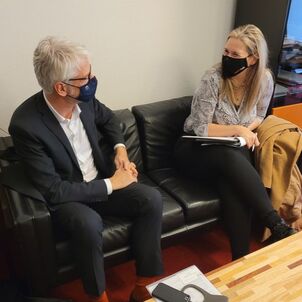
 French Deputy Hubert Julien-Laferrier with Cara Augustenborg | My second day in France started in grandeur with a tour of the French Parliament at the Palais Bourbon and a meeting with Parliamentarian Hubert Julien-Laferrier (member of the Generation Ecologie party). It was impossible not to be impressed with such a salubrious venue, especially the stunning library, and Deputy Laferrier gave me some interesting insights into climate politics and public awareness of climate change in France. |
Another traditional Parisian lunch was enjoyed at the Federation Nationale des Syndicats d’Exploitants Agricoles (FNSEA) – basically the French equivalent of our Irish Farmers Association but with very fancy food! I was surprised how knowledgeable my hosts were about the climate crisis and how their farming members seem to understand agriculture’s essential role in contributing to climate action. Through our conversation, it seemed French farmers consider themselves to be “the victims, the culprits and the solvers” of climate change, and there has been a shift in awareness and acceptance of the need for climate action among the farming community. The last few years of extreme weather events in France (both droughts and flooding) seem to have catalyzed more effort among French farmers to try to adapt their farming practices to climate change. In turn, that’s also helping them to see the need to mitigate against climate change even more. There are definitely lessons to be learned from this experience that can be applied to Ireland’s farming community as they begin to become climate change “solvers” too.
One thing many Irish and French farmers have in common is getting a poor price for their products as “dirtier”, imported foods are cheaper for consumers to buy. In France, on average, the farmer gets EUR 6 of every EUR 100 that a householder spends on food! The rest go to so-called “middle men”. It’s a topic I find myself getting increasingly frustrated about and not understanding why we can’t reduce the profit margins of “middle-men” to give farmers a fair price for food or even slap a sin tax on products that contribute significantly to things like rainforest destruction, climate change, water pollution, etc. That would make “greener” products the cheaper option without encouraging a race to the bottom on price. I am sure trade agreements and food poverty issues make this more complicated than I am stating, but I’d love to see a politician or two prioritize this issue so that farmers had the economic incentive to produce food in a more sustainable way.
After lunch, I headed on to the Confederation Paysanne, which directly translates as “Peasants Confederation” but it’s an older way of describing farmers or “those who work the land” in France. Confederation Paysanne sees farming as a social and ecological profession and has some innovative ideas for how to transform the food system, including looking at national food provision in the same way we view health care as a kind of State managed resource. It’s definitely a concept worth reflecting on as a means of modelling national food security. They also encourage the need for more men and women to become employed in farming as we transition to more sustainable farming practices, which is an interesting way of ensuring a just transition that protects agricultural employment.
I finished the day with the Secretariat of France’s High Climate Council, which is the equivalent of Ireland’s Climate Change Advisory Council. Since they are a relatively new body and I am a relatively new member of Ireland’s Council, we had a lot in common and a great discussion about ways of working and the challenges of setting carbon budgets and conducting annual reviews of Government climate policy. I have a feeling it may be the start of a beautiful friendship as we try to maximize the impact of our respective Councils on climate policy. The French High Climate Council is heavily involved in trying to create an international network of all climate councils so we can learn from each other in developing independent advice on climate policy.
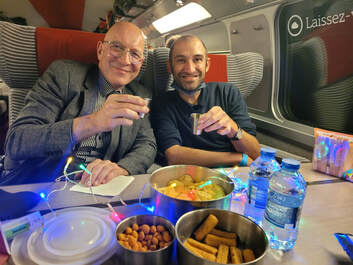 | After my final meeting of the day, I jumped on a high speed TGV train from Paris to Montpellier, traveling 750km in just 3.5 hours, reaching speeds of 350km/hr! It would have taken me 8 hours to do the same journey by car. It definitely now ranks as my favorite form of travel, made even better by my guide’s wise decision to bring snacks, whiskey and Christmas lights for our table! Tomorrow, I get back to my roots with a tour of various agricultural research endeavours around Montpellier in the rain. |
Until then, stay dry and keep fighting the good fight!
-Cara
-Cara
 RSS Feed
