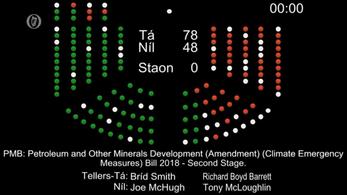
On February 8th, Ireland’s parliament voted 78 to 48 to end future off-shore oil and gas exploration in Irish waters. Their decision mirrors the governments of Costa Rica, Belize and France, who have all banned the exploration of fossil fuels in their waters.
Ireland’s Climate Emergency Measures Bill will provide for the amendment of the Petroleum and Other Minerals Development Act of 1960 to ensure national and global environmental considerations, (including the annual average global temperature and the monthly mean level of carbon dioxide in the atmosphere) are considered when issuing licences, undertakings, and leases under the Act.
Ireland’s Climate Emergency Measures Bill will provide for the amendment of the Petroleum and Other Minerals Development Act of 1960 to ensure national and global environmental considerations, (including the annual average global temperature and the monthly mean level of carbon dioxide in the atmosphere) are considered when issuing licences, undertakings, and leases under the Act.
|
In doing so, the Bill will prohibit further exploration and drilling for new fossil fuel resources anywhere in Irish territorial waters as an emergency measure to address the high levels of carbon dioxide in the atmosphere.
For Valentine’s Day, I could think of no better topic to discuss with Newstalk’s Ivan Yates on our new “Down To Earth” radio slot than Ireland’s exciting systematic break up from fossil fuels! |
Listen to our podcast or read the blog for more of my own opinions on saying good-bye to off-shore oil and gas exploration in Ireland.
The Beginning of The End
New Politics has stirred up some radical changes in Ireland’s Parliament since the 2016 General Election:
- Last June, the Irish Government unanimously banned onshore hydraulic fracturing, or fracking, as the first private members’ bill to pass both Houses during the lifetime of this Government, joining France, Germany and Bulgaria in banning the practice on land. When the final stages of the bill to ban fracking were debated, amendments to extend the ban to offshore drilling were parked to achieve consensus.
- In a 90 to 53 vote last February, the Dail approved legislation to drop coal, oil and gas investments from the €8 billion Irish Strategic Investment Fund through a Bill introduced by an Independent politician, Deputy Thomas Pringle, who credited new politics with advancing this historic legislation. If passed into law soon, Ireland will become the first country in the world to divest from fossil fuels.
- And now, in a record breaking eight weeks, the Dail has agreed to send the Climate Emergency Measures Bill through Committee Stage scrutiny and potentially stop the government from issuing any new licenses for the exploration and extraction of fossil fuels in the State.
Leaders and Laggards
It’s not too surprising that People Before Profit, the Green Party, Labour, Sinn Fein, Social Democrats, and the Solidarity Alliance supported the Climate Emergency Measures Bill as it aligns generally with their ethe, but Fianna Fail’s 11th hour decision to support the Bill sends a significant message with respect to their new direction of travel.
|
Fianna Fail’s 2016 Election Manifesto was light on climate action and made no reference to oil and gas, but since then we’ve seen a “green lean” in their voting record and more engagement in environmental issues, including at their 2017 Ard Dheis where both myself and climate economist, Joseph Curtain, were invited to speak on climate issues. When I met Fianna Fail Leader Michael Martin at the Ard Dheis, he showed a lot of interest in air quality and told me climate change was a very popular issue among the younger Fianna Fail members in particular.
|

Fianna Fail Leader, Micheal Martin, and I pictured at 2017 Ard Dheis with staff from Trocaire.
|
|
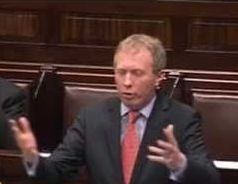
In speaking in the Dail during the second stage hearing of the Climate Emergency Bill, Fianna Fail Environment Spokesperson TD Timmy Dooley leaned even further into the green by emphatically supporting the Bill, stating:
“To continue business as usual is one of the greatest acts of moral negligence that we could commit”. |
It’s a good day for the planet when words that sound like they come from a Green Party manifesto start to make their way into traditional political parties!
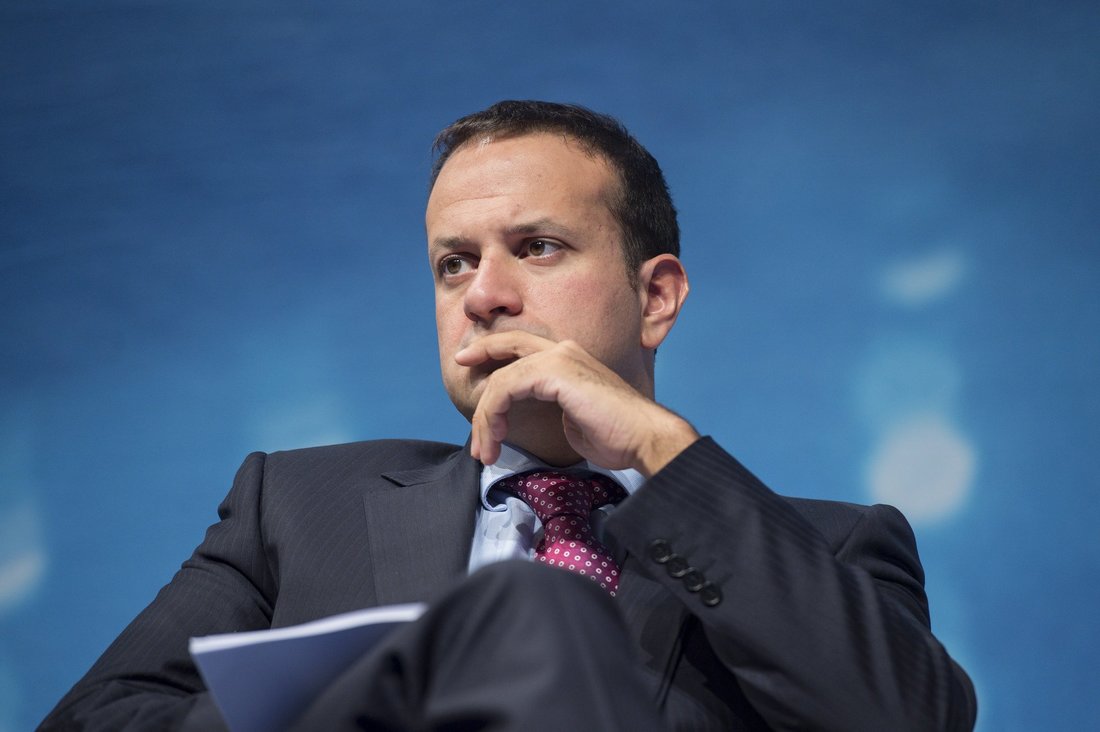
The most surprising aspect of the Dail vote on the Climate Emergency Measures Bill was Fina Gael’s decision not to support the Bill even after Fianna Fail announced their own support. Even more surprising because Fina Gael’s decision came just weeks after Taoiseach Leo Varadkar admitted in European Parliament that his government’s response to climate change was inadequate, stating:
The most surprising aspect of the Dail vote on the Climate Emergency Measures Bill was Fina Gael’s decision not to support the Bill even after Fianna Fail announced their own support. Even more surprising because Fina Gael’s decision came just weeks after Taoiseach Leo Varadkar admitted in European Parliament that his government’s response to climate change was inadequate, stating:
“As far as I am concerned, we are a laggard. I am not proud of Ireland’s performance on climate change ... There are lots of things that we intend to do so that we can meet those targets. |
|
Even our “Independent” Minister for Climate Action, Denis Naughten, voted against the Climate Emergency Bill rather than lose his lovely cabinet seat. I know I shouldn’t be surprised by this in the nasty game of politics, but I genuinely hoped the likes of Naughten and Varadkar (also “MY generation of politicians”) would be better men and leaders than they appear.
If you needed further evidence these guys are all talk and no real climate action, they’ve truly shown their cards on this one.
If you needed further evidence these guys are all talk and no real climate action, they’ve truly shown their cards on this one.
“Twill bring you gain, or perish on the seas”
To give them some credit, Fine Gael’s 2016 Manifesto clearly stated support for oil and gas exploration so they’re sticking to their word in that respect, even if they’re simultaneously contradicting their own National Policy Position to reduce carbon dioxide emissions by at least 80% (compared to 1990 levels) by 2050.
There's a small possibility Fine Gael’s unwavering support of oil and gas exploration is not driven by vested fossil fuel interests but rather a desire for energy sovereignty and some hope of economic benefit from potential new reserves, but every new extraction site threatens our U.N. Paris Agreement commitment to keep climate change under 2°C of warming. The climate science tells us to have a chance of staying under that 2°C limit, we must keep 80% of the world’s known fossil fuel reserves in the ground so there’s no point in looking for more oil and gas because we can’t burn it anyway. This conclusion by expert group Carbon Tracker has been endorsed by the International Energy Agency and the Intergovernmental Panel on Climate Change (IPCC). Research published by Oil Change International in 2016 also found that the oil and gas fields and coal mines that are already in production contain enough CO2 to carry us past the 2°C limit.
The Climate Emergency Measures Bill recognises and legislates for this scientific reality that we must stop looking for more fossil fuel-based energy and is in line with Ireland’s climate and energy obligations as part of the EU and UN. Ireland’s national and international climate commitments require almost complete decarbonisation of the energy, transport and home-heating sectors by 2050.
A vote to support continued exploration of oil and gas is a vote that rejects climate science and turns a blind eye to our international commitments.
There's a small possibility Fine Gael’s unwavering support of oil and gas exploration is not driven by vested fossil fuel interests but rather a desire for energy sovereignty and some hope of economic benefit from potential new reserves, but every new extraction site threatens our U.N. Paris Agreement commitment to keep climate change under 2°C of warming. The climate science tells us to have a chance of staying under that 2°C limit, we must keep 80% of the world’s known fossil fuel reserves in the ground so there’s no point in looking for more oil and gas because we can’t burn it anyway. This conclusion by expert group Carbon Tracker has been endorsed by the International Energy Agency and the Intergovernmental Panel on Climate Change (IPCC). Research published by Oil Change International in 2016 also found that the oil and gas fields and coal mines that are already in production contain enough CO2 to carry us past the 2°C limit.
The Climate Emergency Measures Bill recognises and legislates for this scientific reality that we must stop looking for more fossil fuel-based energy and is in line with Ireland’s climate and energy obligations as part of the EU and UN. Ireland’s national and international climate commitments require almost complete decarbonisation of the energy, transport and home-heating sectors by 2050.
A vote to support continued exploration of oil and gas is a vote that rejects climate science and turns a blind eye to our international commitments.
Left in the dust
Even if we park the climate science and UN commitments for a moment and consider Fine Gael’s argument on the importance of oil and gas as an indigenous natural resource which enhances our national energy “security”, our paltry oil and gas reserves don’t contribute to any sense of national energy security. According to the Sustainable Energy Authority of Ireland, 85 per cent of Irish energy is imported in 2016 at an annual cost of around €4.6 billion, with 91 per cent of this coming from fossil fuels so very little of our energy comes from Irish sources. We’re almost completely dependent on costly foreign imports. Furthermore, there are no indications that any future gas finds in Irish waters are likely or economically viable. Corrib gas field project incurred losses of €2bn and Shell exited the project in 2017, after losing $900m.
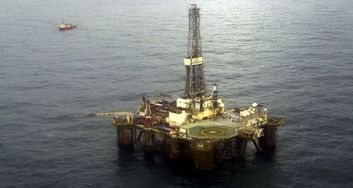
The Corrib gas field currently meets 40% of our demand and this will increase to over 60% until the mid-2020s, but it's important to note that revenue from these gas supplies does not go to the Irish state and we pay the same as any other country would to purchase this gas.
The Corrib gas field currently meets 40% of our demand and this will increase to over 60% until the mid-2020s, but it's important to note that revenue from these gas supplies does not go to the Irish state and we pay the same as any other country would to purchase this gas.
IrishTimes.com
|
Exploration and extraction are dominated by major fossil fuel companies who sell their supplies at the market price with no discount or royality to us here in Ireland thanks to a deal made by Charlie Flanagan's government in 1989 which gave all the rights to our own oil and gas away.
|
Despite this lack of benefits to the State, there are currently over 40 licenses granted for a range of fossil fuel, some of which have contracts up to the late 2020s. Any continued exploration and extraction of fossil fuels, if successful, locks Ireland into burning those fossil fuels when the State is already failing in its climate change commitments. The introduction of new gas sources would require the costly construction of new gas infrastructure which would remain in place for decades. New gas supplies also encourage increased gas usage by homes and businesses at a time when usage should be decreasing.
As part of its examination of the Onshore ‘Fracking Act’ in 2016, the Joint Oireachtas Committee on Communications, Climate Action and Environment produced a detailed report on fossil fuel supplies in Ireland, acknowledging that ‘further investment in exploitation of fossil fuels would in all likelihood reduce investment in sustainable sources of energy.’ It’s clear that a continued focus on oil and gas exploration, leaves us in the dust when it comes to the renewable energy transition we need to make.
As part of its examination of the Onshore ‘Fracking Act’ in 2016, the Joint Oireachtas Committee on Communications, Climate Action and Environment produced a detailed report on fossil fuel supplies in Ireland, acknowledging that ‘further investment in exploitation of fossil fuels would in all likelihood reduce investment in sustainable sources of energy.’ It’s clear that a continued focus on oil and gas exploration, leaves us in the dust when it comes to the renewable energy transition we need to make.
The Future Is Electric
Research by the Stop Climate Chaos Coalition shows that Ireland would be far better off investing in local renewables and warmer homes that use less fuel than looking for more oil and gas. Ireland has one of the highest levels of fossil fuel use in electricity generation in comparison with other European countries and disproportionality high electricity bills as a result . Real savings and benefits to Irish citizens arise where those is no purchase of fossil fuels, be that imported or indigenous, not to mention all the co-benefits of a healthier environment without the risks of drilling.
In 2016, renewable energy in Ireland reduced our national energy import bill by €342 million. Moving to a fossil fuel free energy grid based on Renewable sources has the capacity to create 100,000 jobs in Ireland. Real energy security comes in the form of clean, zero carbon, indigenous renewable resources, not fossil fuel sources with dangerous extraction processes and grave climate implications.
Fossil fuel investment also now carries major financial risks. Financial analysts have highlighted the risks of fossil fuel assets becoming ‘stranded’ (worthless), a warning reiterated publicly by the Governor of the Bank of England, Mark Carney.
Enacting the Climate Emergency Measures Bill would create further impetus in Ireland to drive more Renewable Energy development and decarbonize transport and energy. This would be a positive step not only in reducing our greenhouse gas emissions, but also in attracting companies like the big data centres looking for fossil-fuel free locations to set up premisis. In addition, it will be one of only a handful of laws like it internationally and thus a rallying call to others to act.
Varadkar’s ambition to drop the “climate laggard” label could begin to be realized with no tangible cost to the Exchequer if only his party would agree to support the Climate Emergency Measures Bill.
In 2016, renewable energy in Ireland reduced our national energy import bill by €342 million. Moving to a fossil fuel free energy grid based on Renewable sources has the capacity to create 100,000 jobs in Ireland. Real energy security comes in the form of clean, zero carbon, indigenous renewable resources, not fossil fuel sources with dangerous extraction processes and grave climate implications.
Fossil fuel investment also now carries major financial risks. Financial analysts have highlighted the risks of fossil fuel assets becoming ‘stranded’ (worthless), a warning reiterated publicly by the Governor of the Bank of England, Mark Carney.
Enacting the Climate Emergency Measures Bill would create further impetus in Ireland to drive more Renewable Energy development and decarbonize transport and energy. This would be a positive step not only in reducing our greenhouse gas emissions, but also in attracting companies like the big data centres looking for fossil-fuel free locations to set up premisis. In addition, it will be one of only a handful of laws like it internationally and thus a rallying call to others to act.
Varadkar’s ambition to drop the “climate laggard” label could begin to be realized with no tangible cost to the Exchequer if only his party would agree to support the Climate Emergency Measures Bill.
But First...
Perhaps I celebrated a bit prematurely when I heard the news that the Climate Emergency Measures Bill had passed second stage, but we get so few opportunities to celebrate victories in the environmental arena.
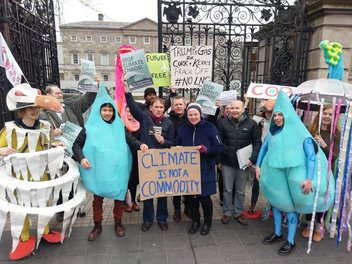
Not Here Not Anywhere protests outside Leinster House to support the Climate Emergency Measures Bill
|
I was reminded by several colleagues after my happy dance that this was just one battle and the war is far from won. -The Bill could easily get stalled in Committee stage or watered down to a meaningless piece of paper. Climate Action and Environment Committee Chairperson, Fine Gael’s Hildegard Naughton, already hinted at this prospect during the Bill’s debate when she said pros and cons needed to be considered before legislation could be drawn up.
|
If opponents have their way, climate change will drop to bottom of considerations in the Bill to squeeze a bit more oil money into their campaign coffers while they still can.
It’s important to note that the Bill will not disrupt Ireland’s current gas supply or jeopardise the energy demands of citizens and businesses in Ireland. The policy change proposed in the Bill will not ‘switch off’ any existing supplies and does not affect current exploration licences. Gas Networks Ireland have emphasised no new gas sources are required for Ireland to maintain its gas supply in the short, medium or long-term because Ireland is connected to the UK gas system and not reliant on natural gas exports from the Russian Federation but instead via Scotland from the North Sea and from continental Europe via England. Furthermore, the UK’s decision to exit the EU does not jeopardise gas flows to Ireland or Northern Ireland.
While the Bill can now proceed to Committee Stage, there are concerns the government could block the Bill at a later stage or water it down when amendments can be made to the wording. It’s critical that voters force their representatives to stick to the science and back the Bill as it stands as soon as possible to ensure it becomes a law that aligns with climate science and a sustainable Ireland.
You can make your voice heard on this issue by joining the newsletter at www.foe.ie.
While the Bill can now proceed to Committee Stage, there are concerns the government could block the Bill at a later stage or water it down when amendments can be made to the wording. It’s critical that voters force their representatives to stick to the science and back the Bill as it stands as soon as possible to ensure it becomes a law that aligns with climate science and a sustainable Ireland.
You can make your voice heard on this issue by joining the newsletter at www.foe.ie.

|
As always, keep fighting the good fight, and tune in to Newstalk FM on Wednesday's 6:45-7pm for more debate between Ivan Yates and I on the Down To Earth slot on the Hard Shoulder.
-Cara |
 RSS Feed
